
Poor Adherence and Awareness of AHA Guidelines
Understanding the AHA, ACC, and HRS guidelines that establish the standards for ECG acquisition, interpretation, and cardiac monitoring
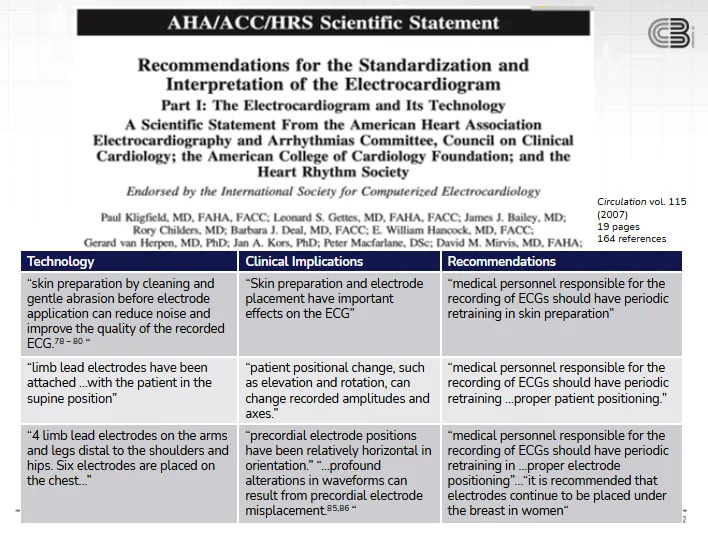
Why ECG Standardization Matters
Despite decades of established guidelines, many healthcare professionals remain unaware of the specific AHA, ACC, and HRS recommendations for ECG standardization. This knowledge gap can lead to inconsistent electrode placement, improper filter settings, and ultimately, diagnostic errors that affect patient outcomes.
Diagnostic Accuracy
Standardized ECG techniques ensure consistent, accurate diagnoses across different healthcare settings and providers.
Patient Safety
Adherence to AHA guidelines reduces the risk of missed diagnoses and inappropriate treatment decisions.
Legal Protection
Following recognized standards of care provides documentation of appropriate clinical practice.
Quality Improvement
Guidelines provide benchmarks for measuring and improving ECG acquisition and interpretation quality.
Guidelines by Organization
Key standards from leading cardiac care authorities
The AHA publishes comprehensive guidelines for ECG standardization and interpretation that form the foundation of cardiac monitoring best practices worldwide.
Key Guidelines & Documents
Recommendations for the Standardization and Interpretation of the Electrocardiogram
Comprehensive standards for ECG acquisition, electrode placement, and waveform interpretation
Standards for Analysis of Ventricular Late Potentials
Guidelines for signal-averaged ECG techniques and interpretation
Practice Standards for Electrocardiographic Monitoring in Hospital Settings
Standards for continuous ECG monitoring in clinical environments
Key Standardization Points
- Standardized electrode placement ensures reproducible ECG recordings
- 10-second recording standard for resting 12-lead ECGs
- Specific filter settings recommended for different clinical applications
- Quality control measures for ECG equipment calibration
The ACC, often in collaboration with AHA, develops clinical practice guidelines that establish standards of care for cardiovascular conditions and diagnostic procedures.
Key Guidelines & Documents
ACC/AHA Guidelines for Ambulatory Electrocardiography
Standards for Holter monitoring and ambulatory ECG assessment
ACC/AHA/HRS Guidelines for the Management of Patients with Ventricular Arrhythmias
Comprehensive guidance on arrhythmia detection and management
Appropriate Use Criteria for ECG Monitoring
Evidence-based criteria for selecting appropriate ECG monitoring strategies
Key Standardization Points
- Risk stratification algorithms for sudden cardiac death
- Indications for continuous vs. intermittent monitoring
- Integration of ECG data with clinical decision-making
- Quality metrics for ECG interpretation accuracy
HRS is the leading resource for cardiac arrhythmia professionals, providing expert consensus documents and guidelines focused specifically on cardiac rhythm disorders.
Key Guidelines & Documents
HRS/EHRA/APHRS/LAHRS Expert Consensus Statement on Optimal Implantable Cardioverter-Defibrillator Programming
Standards for device programming to optimize arrhythmia detection
HRS Expert Consensus Statement on the Diagnosis and Treatment of Arrhythmias
Guidelines for identifying and treating cardiac rhythm abnormalities
Mobile Health Devices for Cardiac Rhythm Diagnosis and Management
Emerging standards for wearable and mobile ECG technologies
Key Standardization Points
- Specialized criteria for arrhythmia detection algorithms
- Standards for signal quality in ambulatory monitoring
- Guidance on emerging wearable ECG technologies
- Recommendations for remote cardiac monitoring
EXG™ Platform & Guideline Compliance
How the EXG™ Wearable ECG Platform aligns with established standards
AHA-Compliant Electrode Placement
Designed for precise, standardized electrode positioning per AHA recommendations
12-Lead Acquisition Standards
Full 12-Lead ECG acquisition meeting ACC diagnostic standards
Arrhythmia Detection
Algorithm design informed by HRS arrhythmia detection criteria
Signal Quality Standards
Exceeds minimum signal quality requirements for diagnostic ECG
Continuous Monitoring
Supports ambulatory monitoring per ACC/HRS guidelines
Training & Education
Comprehensive training program based on guideline recommendations
Built with Compliance in Mind
The EXG™ platform was designed from the ground up to meet and exceed the standards set by AHA, ACC, and HRS guidelines.
Request a DemoDisclaimer: This page provides general educational information about ECG standardization guidelines. For complete and current guideline documents, please refer to the official publications from AHA, ACC, and HRS. Clinical decisions should be based on the full guideline documents and individual patient circumstances.
Learn More About Guideline-Compliant ECG Monitoring
See how the EXG™ platform is designed with AHA, ACC, and HRS guidelines in mind